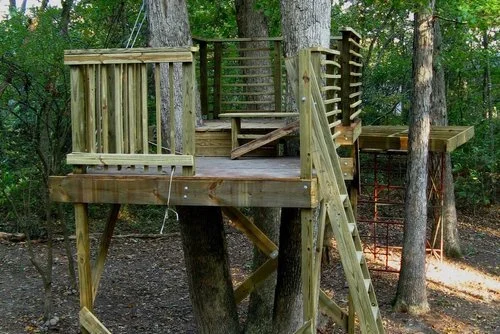
There is an
attraction between trees and children. A tree's constant motion even in
the stillest air, and its great size and reach make a tree fascinating.
At some stage during child development, when motor skills and hand grip
are refined and strong, tree climbing becomes a play task. The world is
filled with trees to climb.
The next logical step after tree climbing and attaching swings in
trees, is imagining a treehouse. As in all imaginative play, the most
basic structure in a tree can represent a castle in the clouds or a
jungle hide-a-way. When you see your ten-year-old headed with a hammer,
nails and scrap lumber toward your yard tree, there are some immediate
decisions to be made. Safety to children is the only major concern.
Here will be reviewed some minor tree issues you need to think about.

|
Trees do not heal
wounds, but seal them off and grow over old injuries. Once wounded, the
tree is injured for life. Minimizing the number and depth of injuries
can help a tree cope with a treehouse. Minimize the number of separate
injuries inflicted, especially to the main stem. Branches are
disposable compared to the trunk, and should bare the majority of any
wounds. In other words, mess with the branches not the main trunk of
the tree.
Trees
should be selected that have large, strongly connected limbs on
the lower part of the stem. Selectively prune away branches, sprouts
and twigs that, when weighed with rain and propelled by winds, will not
slash sideways or up and down into the area of a treehouse. Make proper
pruning cuts to remove branches. Do not use pruning paints on any
wounds. |
Treehouses should
be designed to rest upon major branches and to nestle around the trunk.
This will minimize the need for any injurious attachments. Remember
trees bend and twist in the wind, so simply jamming or wedging boards
between branches or into crotches will lead to failure.
|
Assure a
treehouse stays snug
against a
branch by using rope. All rope attachment hardware should be on the
treehouse,
not screwed into the tree.
Attaching a treehouse to tree branches with rope can prevent large wind
storms from blowing a treehouse away, or prevent ambitious and
ingenious children from changing design concepts and injuring
themselves. |
Depending upon how a treehouse will be attached and positioned in the
tree, wrap the main stem and basal portions of major branches with
layers of corrugated cardboard held with snug, not tight, wire. This
cardboard cover should not be attached where there will be need of hand
and foot holds. Cardboard will help protect the bark during treehouse
installation and general play in the tree.
Carefully consider how children will enter the treehouse. Do not nail
individual ladder rungs to the trunk for climbing. Utilize a
self-supporting ladder tied to the tree, or a heavy, unlooped, knotted
rope for entering the tree. Remember that most in-tree injuries occur
when climbing up and down. For many trees with low branches, a ladder
or rope for entry is unneeded and represents a safety concern.
Next determine how high off the ground to build a treehouse. For most
play, any height above the ground represents the thrill of a treehouse.
Build a treehouse for easy and safe access, not to maximize height
above the ground. Three to five feet above the ground in a tree with
low, reclining branches can be easy to construct and to maintain.
Unfortunately, taller trees and branches are more common, resulting in
higher treehouses. Construction problems greatly increase with
increasing height above the ground. Whatever the height, insist that
children not jump from the treehouse to the ground. Always climb down
the trunk, ladder, or rope.
Within the tree, treehouses should be built in the bottom one-third of
tree. Determine the total height of the tree, divide by three and keep
the treehouse structure in the lowest third of the tree. If attachments
are needed, attach the treehouse only to the branches, not the trunk.
Position the treehouse so it rests or is attached to the basal
one-third of each branch.
Wooden materials should be used in building a tree house. Wood is
"soft" on the tree and children, is strong for its weight, and
withstands bending and mechanical shocks well. Attach the main floor
pieces or braces to branches with heavy rope in multiple wraps. Do not
use metal nails or screws in a tree. If further stability assurance is
needed, pick one to three branch sites (not on the trunk) for
installation of single metal eye-bolts.
Use eye-bolts with round washers and a nut. Pre-drill eye-bolt holes
one-sixteenth of an inch larger than the eye-bolts shafts. Drilling
requires a special extra-long bit for big branches. Do not use any type
of lubrication on the bolts and do not attempt to seal the edges of the
drilled hole. Tighten the nut firmly against the washer on the back
side. The washer should be seated into the bark only as far as the
surface of the wood. Do not scrape pieces of the bark off the tree
larger than the bolt washer. Minimize the surface area of any damage.
Treat these support bolts as permanent additions to the tree and do not
remove them each year. The eyebolts should be inserted in a vertical
position, never horizontal across a branch. Only branches should be
drilled in this way, never the main stem. Select strong branch anchor
sites in the lowest third (segment length closest to stem) of the
branch. Avoid inserting bolts into areas with decay or visible
structural faults. Use sharp bits and saws for clean cuts.
The weight of the treehouse should be supported by big tree branches.
Use multiple wraps of rope around the branch, through the eye-bolts,
and around treehouse parts in attaching the treehouse to a tree. These
rope attachments should keep the treehouse in position but not bear its
full weight against gravity. All loose ends of rope should be tied-up
or melted into a knot. Remember, treehouses should be temporary,
seasonal structures that are removed each year. This allows a tree time
for adjustment, and a parent time to check and repair the treehouse.
Use new, synthetic, heavy rope for reattachment each year.
Treehouse structures need to move with the tree. Tree trunks and
branches have three primary movements: twist, sway, and bounce. During
normal winds, the tree house must be able to flex and slide enough to
not damage the tree, pull itself apart, or break loose from its
attachments. The bottom and inner third of the tree crown has much less
movement than higher portions. Attachments, like synthetic rope, that
can flex slightly with tree movements are ideal.
The floor area of the treehouse should be slightly tilted to shed
water. Any water falling on the treehouse should be allowed to run-off
away from the tree trunk and fall freely to the ground. Water and leaf
litter should not be allowed to accumulate on or inside a treehouse.
Wet leaves and twigs can be slippery and initiate structural decay in
wood supports.
Build-in thin, open gaps along the bottom and top of the treehouse to
allow for good air circulation, for water drainage, for plenty of
light, and for breezes to blow tree litter away. These gaps also allow
the interior of the treehouse to be seen from the ground. This visual
assessment is necessary to see if the treehouse is occupied, or if an
injured child in inside.
Any walls built on a treehouse must stand the pressure of bodies
pushing from the inside-out and wind pushing from the outside-in. One
means of testing walls, floors, and roofs in a treehouse is for an
adult to carefully enter the treehouse platform, lean against walls,
and shake the whole treehouse. Usually the strength and weight of an
adult will make any structural weaknesses apparent. Treehouse
structures will weaken over time and should be checked monthly, removed
in the cold season, and examined after every storm.
An unexpected major liability problem in a treehouse is the structural
parts breaking apart, flying-off, and striking surrounding people and
property in windstorms. Treehouse must be constructed well to hold up
to children and the environment in a tree. Tree will flex and push upon
a treehouse and winds will buffet a treehouse. Strong construction and
simple designs will maximize the usable and safe life-span of a
treehouse.
Do not allow children to occupy a treehouse in storms, heavy rains, or
anytime lightning is a possibility. Even if a treehouse is enclosed
with a roof, it is no place to play in wind and rain storms. Do not
allow overnight camping or sleeping. Treehouses are meant for daylight
play. In-tree camping requires special precautions and equipment. Young
children should not be allowed or tempted to climb in or around a
treehouse. Control access through fencing, access ladders, and ropes.
Do not install or allow wires, electrical lines, heat sources, fires,
or metal poles in or around a treehouse. Any tree selection process for
building a treehouse should have already eliminated trees near utility
lines, antennas, chimneys, and over-hanging roofs.
Do not paint hand holds or walking surfaces. Leave these surfaces in
natural wood or use a roughening agent to assure firm and certain
traction. Do as much painting of treehouse parts on the ground and
avoid painting tree parts. Do not paint bindings or structural
fasteners, as this can hide problems or lead to strength loss. Check
knots, bindings, and bolts for damage and loosening. In winter
carefully dismantle the treehouse and discard old rope, and damaged or
degraded materials.
Treehouses may be for kids, but require adult construction and
supervision for safe play and for minimizing damage to the tree.
Treehouses are inherently dangerous and require careful maintenance,
but treehouses can be fun, educational, and challenging. Other forms of
tree houses not discussed here are fully functional houses in a tree
and special artistic treehouses used for advertising.
Whatever the use of a treehouse, remember to defend the life of a tree
that will stand long after any treehouse is gone and the children have
departed. Piece together your treehouse carefully to minimize major,
long-term tree injuries.
Source:
Kim
D. Coder
Professor,
Silvics/Ecology
Warnell
School of Forest
Resources
The
University of Georgia
|
excerpted
from
View
from the Trees
We're only about
ten feet up off the ground, but the distance feels tenfold greater as I
gaze out over rooftops and across the brush to fields and houses
beyond. Here we are uplifted, held aloft by strong limbs, and separated
from standard time. Here we are eye-to-eye with the birds, as far
removed from ground-level reality as an eagle in its aerie. Shrouded in
leafage, we can peer out at passersby who never seem lift their heads
above the horizontal plane; to them we are invisible. Almost every kid
who grows up in the country knows what it's like to climb trees. And
nearly everyone who has ever climbed a tree has built a treehouse... or
dreamed of one.
Treehouses
View
From the Top
by
John Harris
The
Lyons Press, 2003
John Harris,
the
author of
this collection of world-class treehouses, heads a treehouse
construction
firm based in Scotland called "The TreeHouse Company." Over
the past
five years Harris' crews have designed and constructed over 500
treehouses
ranging from Wick in northern Scotland through to Zambia in Africa and
from the Far East of Russia to Mustique in the Caribbean.
"Treehouses can
be found
in the most unexpected and secret places on Earth," Harris points out.
"I've been told of a hollowed out tree that was used as a ticket office
on Britain's Great Western Railway last century; of a cyber cafe found
two hours from civilization in Southern Turkey, high in the treetops;
of
an oak tree fused with a church in Normandy called 'Le Chene Classe,'
that
has been used as a chapel for over 800 years. Treehouses are never far
away -- ask around. There's probably one in your town, hidden above
your
head amid the leaves."
Harris' book is
an inspiration
to anyone who has built or dreamed of building a treehouse.
It profiles
22 uniquely designed treehouses in detail, from a simple "Apple
Treehouse"
playroom for children to a two-storied "Treehouse in France" spread
across
a number of trees, as well as a cozy "Red Office Treehouse," a
"Treehouse
Study," a festive dining room in the sky complete with a full kitchen,
and a "Conference Treehouse" complex.
The book's
introduction traces
the long history of treehouses from Emperor Caligula's "Eyrie," where
guests
were entertained by jugglers and acrobats, to the world's largest
treehouse
complex now under construction in Northhumberland, England.
Detailed
case studies
of the 22 featured treehouses include specifics on the design and
construction
of each structure, explaining the steps builders took to conserve the
host
tree and how it is suited to the structure. Materials used in
construction
are listed.
The final
chapters explain
how to build a treehouse, detailing an actual treehouse construction
project
by The TreeHouse Company. Step-by-step instructions for building a
treehouse
are included.
"The best shaped
trees for
treehouse construction are those that resemble an upturned palm, as
these
have a natural space in the crown of the tree for holding the
body
of the treehouse," Harris explains. "The best varieties of European
tree
that The TreeHouse Company most commonly build in are beech, oak, ash,
chestnut, sycamore, lime, and larger pines and spruces, however most
species
of tree will be capable of holding a treehouse. Whatever type of tree
you
choose, remember that it must be semi-mature or mature and in
good
health."

Build
Your Kids a Treehouse

The
Treehouse Book

Treehouses
of the World
|